Does an agent fail to discover useful information, or fail to use what it already knows?
Exploration discovers new information; exploitation uses acquired knowledge to complete tasks.
We measure exploration and exploitation errors directly from action trajectories,
without access to the agent’s internal policy or a fixed reference strategy.
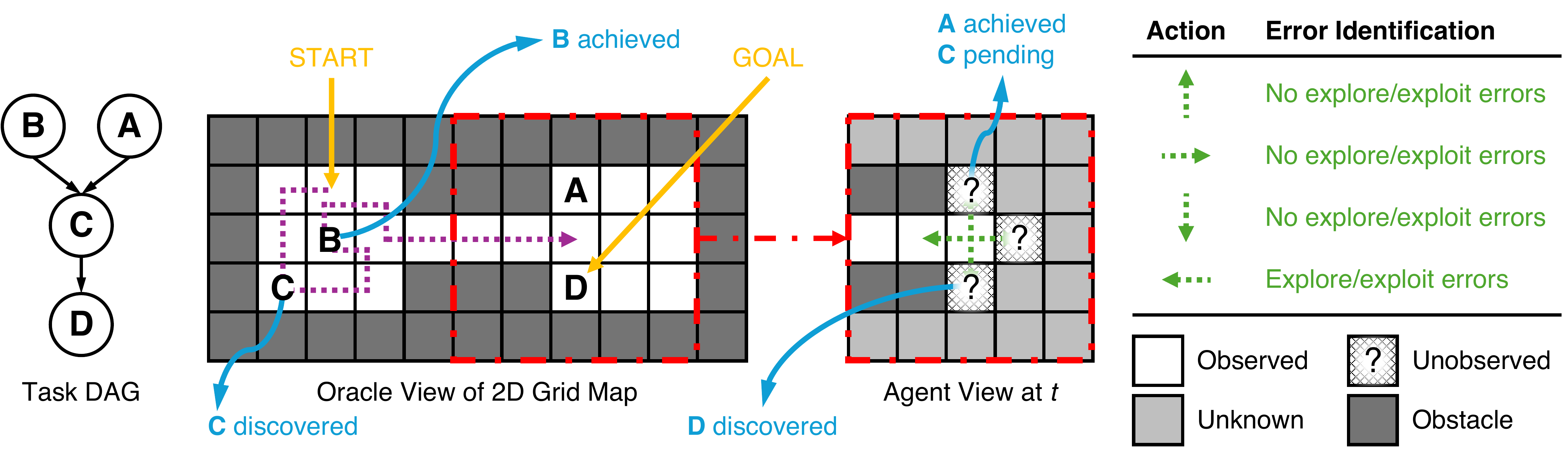
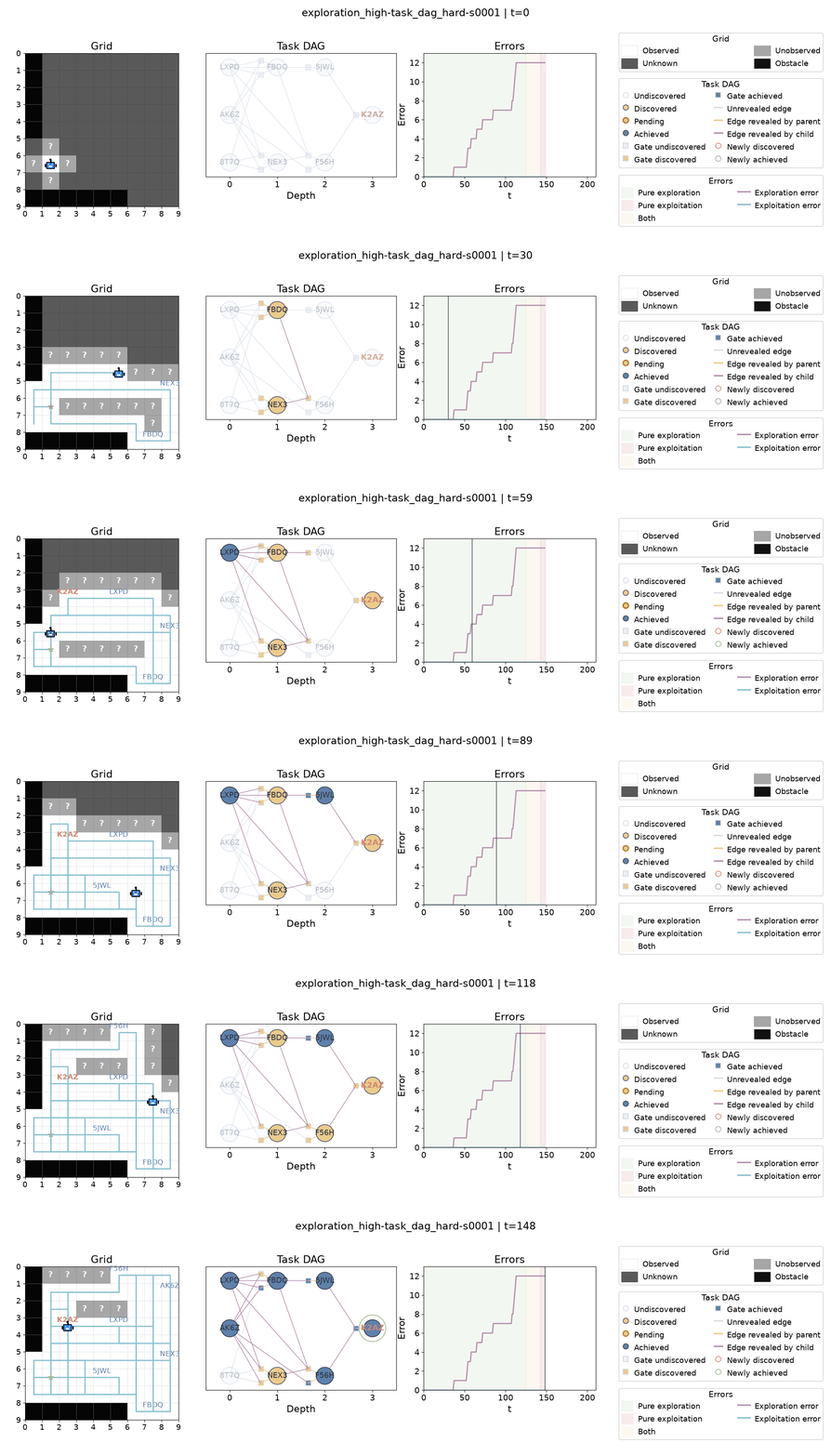
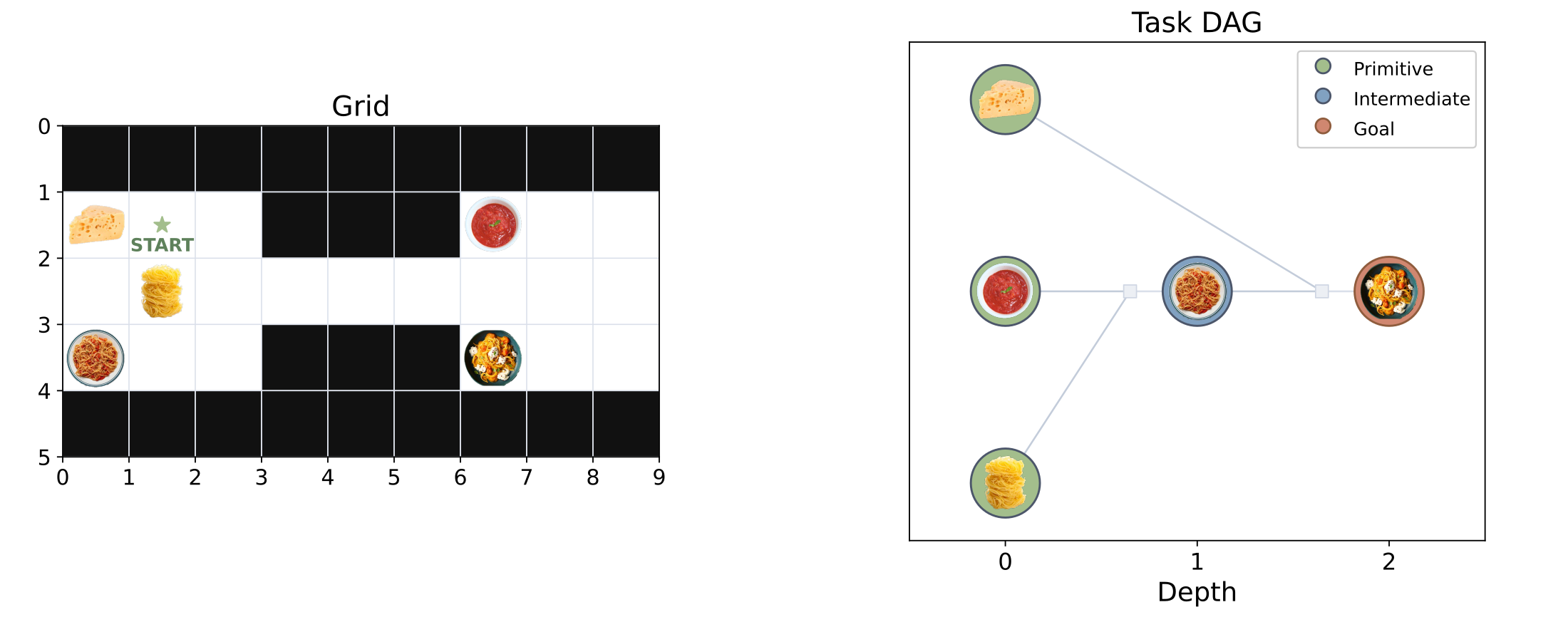
Figure 1. Each episode pairs a partially observed 2D grid with an unknown symbolic task dependency graph
(a directed acyclic graph, or DAG).
Agents must discover task locations, satisfy prerequisites, and return to nodes that are ready to activate.
02 / Results
Main Takeaways
We evaluate 35 language models with four prompt strategies, with and without reasoning.
Success means reaching the goal within the step budget.
The error decomposition explains behavior that task success alone cannot capture.
Takeaway 1
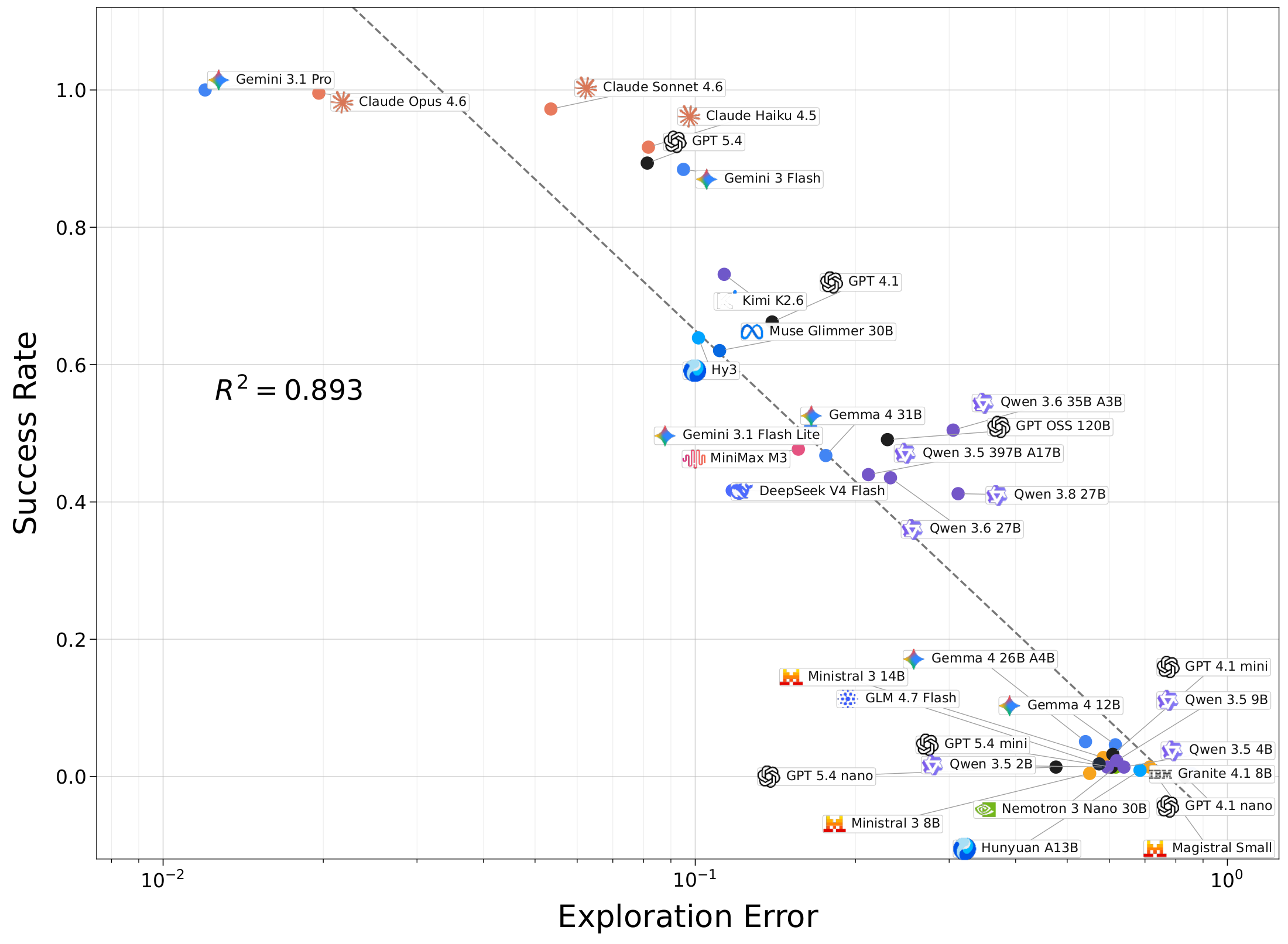
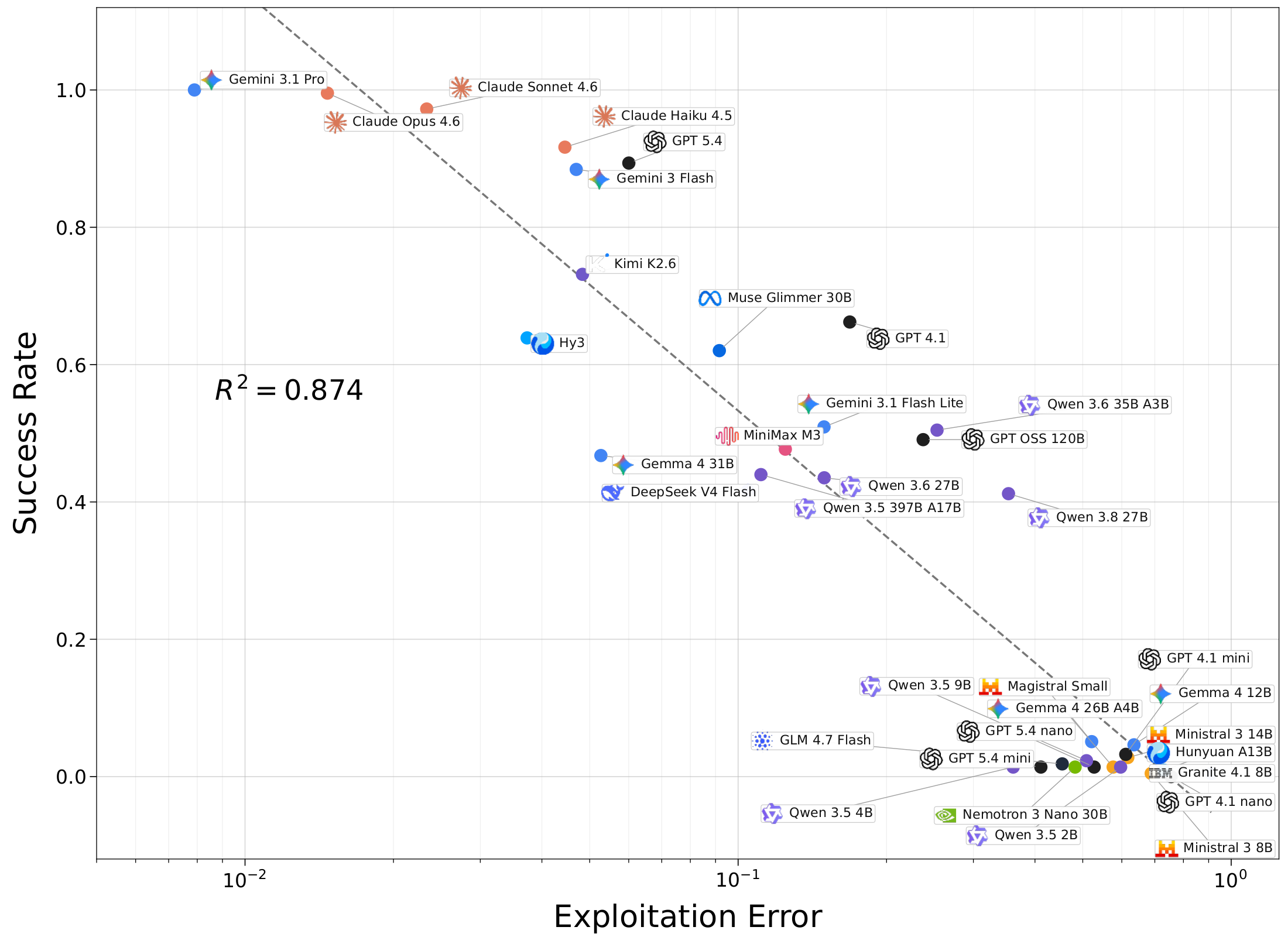
Both exploration and exploitation errors predict success.
Across 35 models, success has strong negative linear relationships with
log exploration error (R² = 0.893) and
log exploitation error (R² = 0.874).
Agents need to discover useful states and use that knowledge to complete the task.
Figure 2a. Success versus exploration error.Figure 2b. Success versus exploitation error.
These errors summarize trajectory behavior and complement success rate; they are not standalone rankings of overall agent quality.
Takeaway 2
The same successful outcome can hide opposite failure modes.
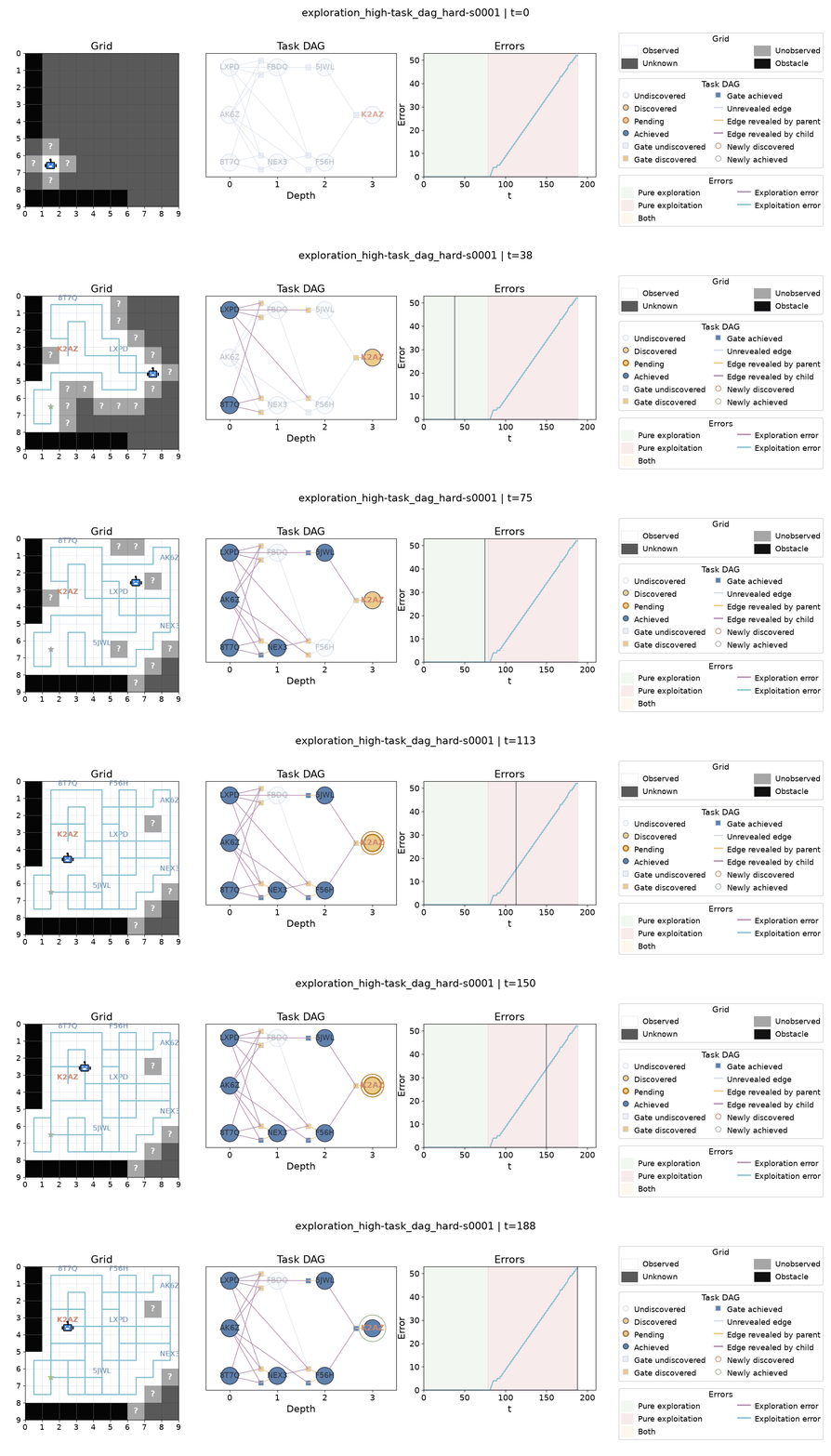
On the same map and prompt, Hy3 and GPT-OSS-120B both reach the goal.
Yet Hy3 incurs only exploration errors, while GPT-OSS-120B incurs only exploitation errors.
The metric reveals which behavior needs improvement in each trajectory.
Table 1. Two successful trajectories on the same episode.
Model
Steps / budget
Exploration error
Exploitation error
Hy3
148 / 210
8.1%
0.0%
GPT-OSS-120B
188 / 210
0.0%
47.3%
Figure 3a. Hy3 reaches the goal in 148 steps.
Figure 3b. GPT-OSS-120B discovers the goal at step 22 and satisfies its prerequisites by step 78,
but takes another 110 steps to reach it at step 188. Of those 110 steps, 52 are exploitation errors.
This is a comparison of two individual trajectories. Each error rate is normalized over the steps where that behavior is relevant.
Takeaway 3
Prompts can steer exploration and exploitation.
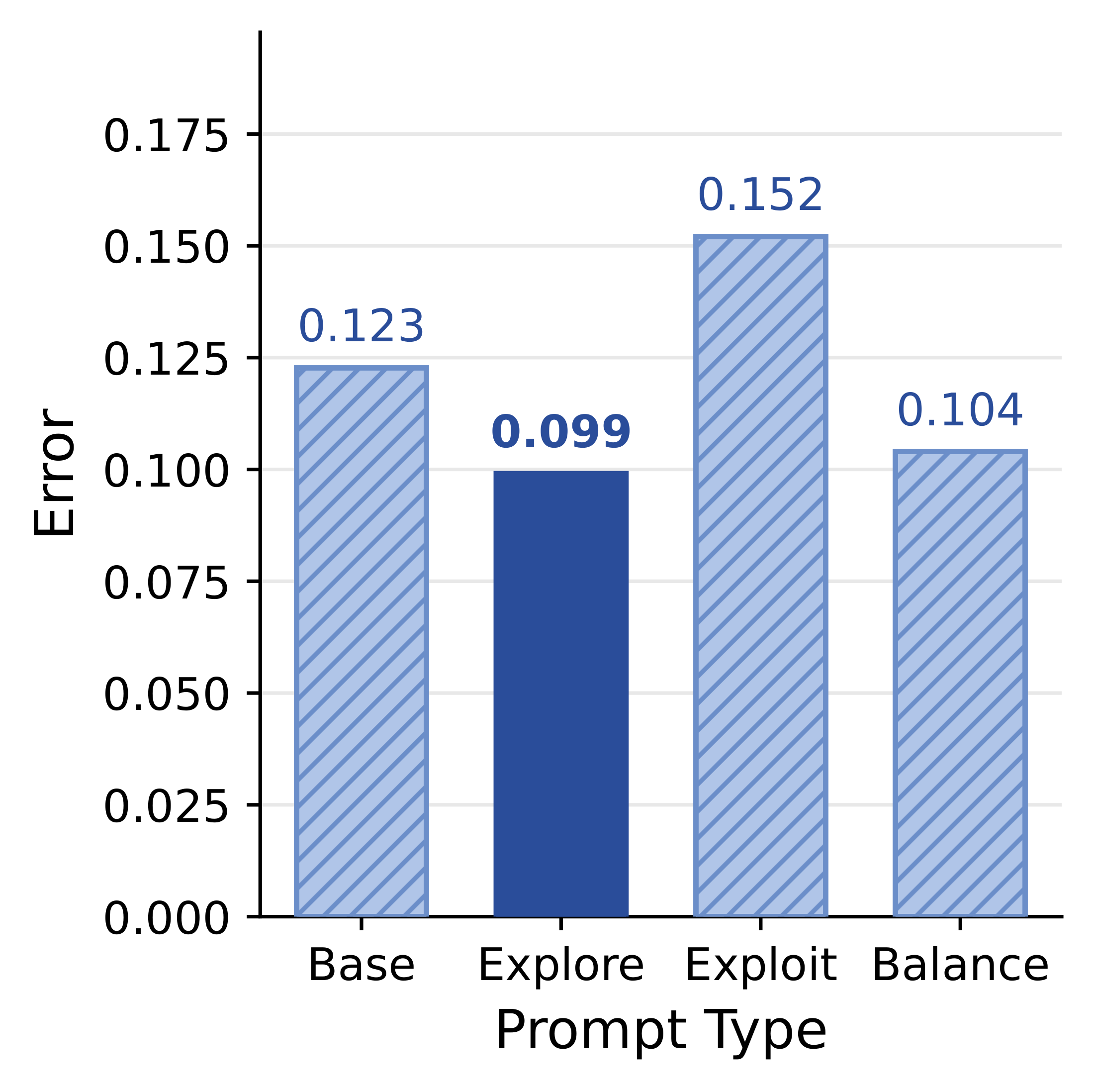
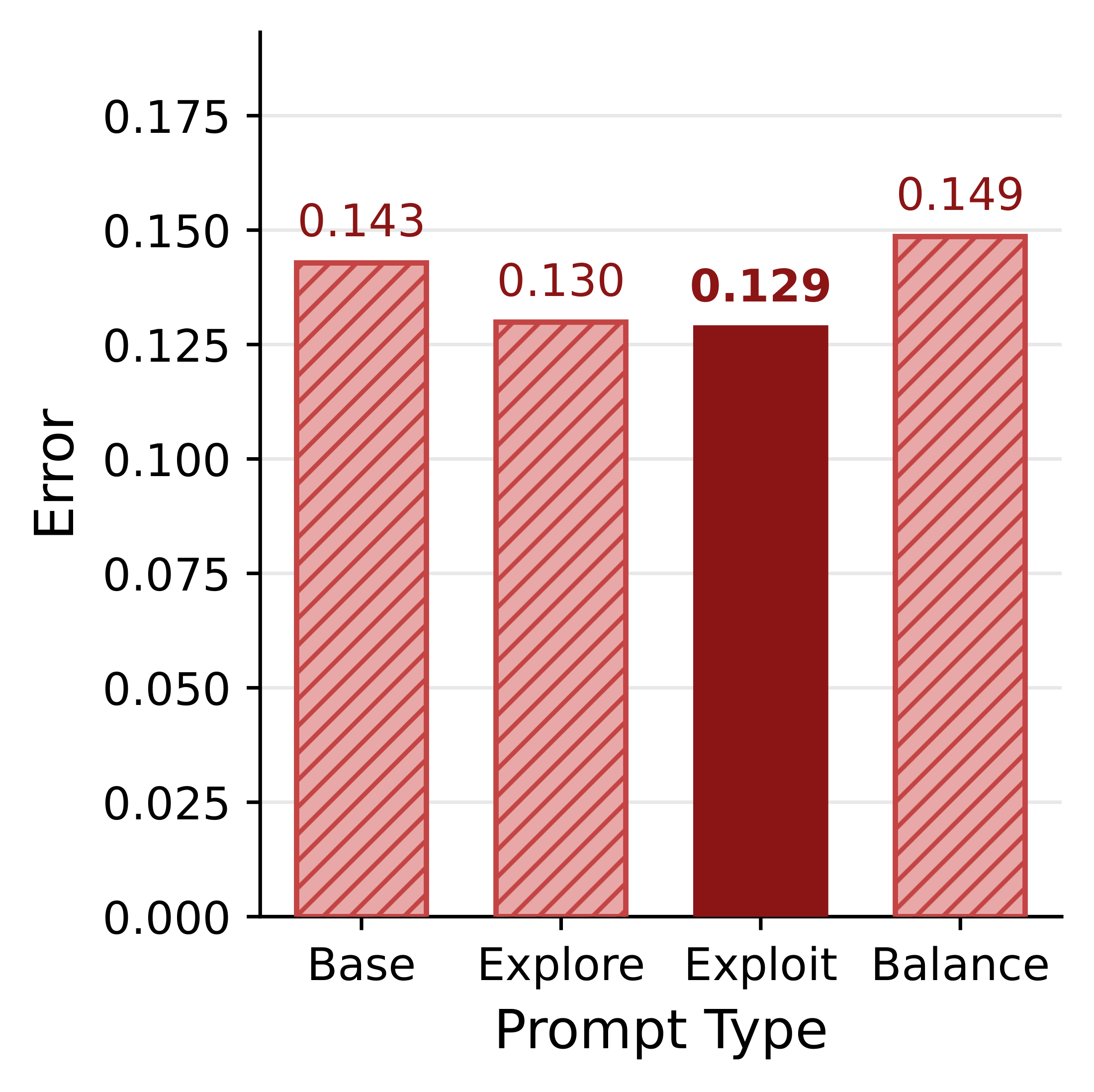
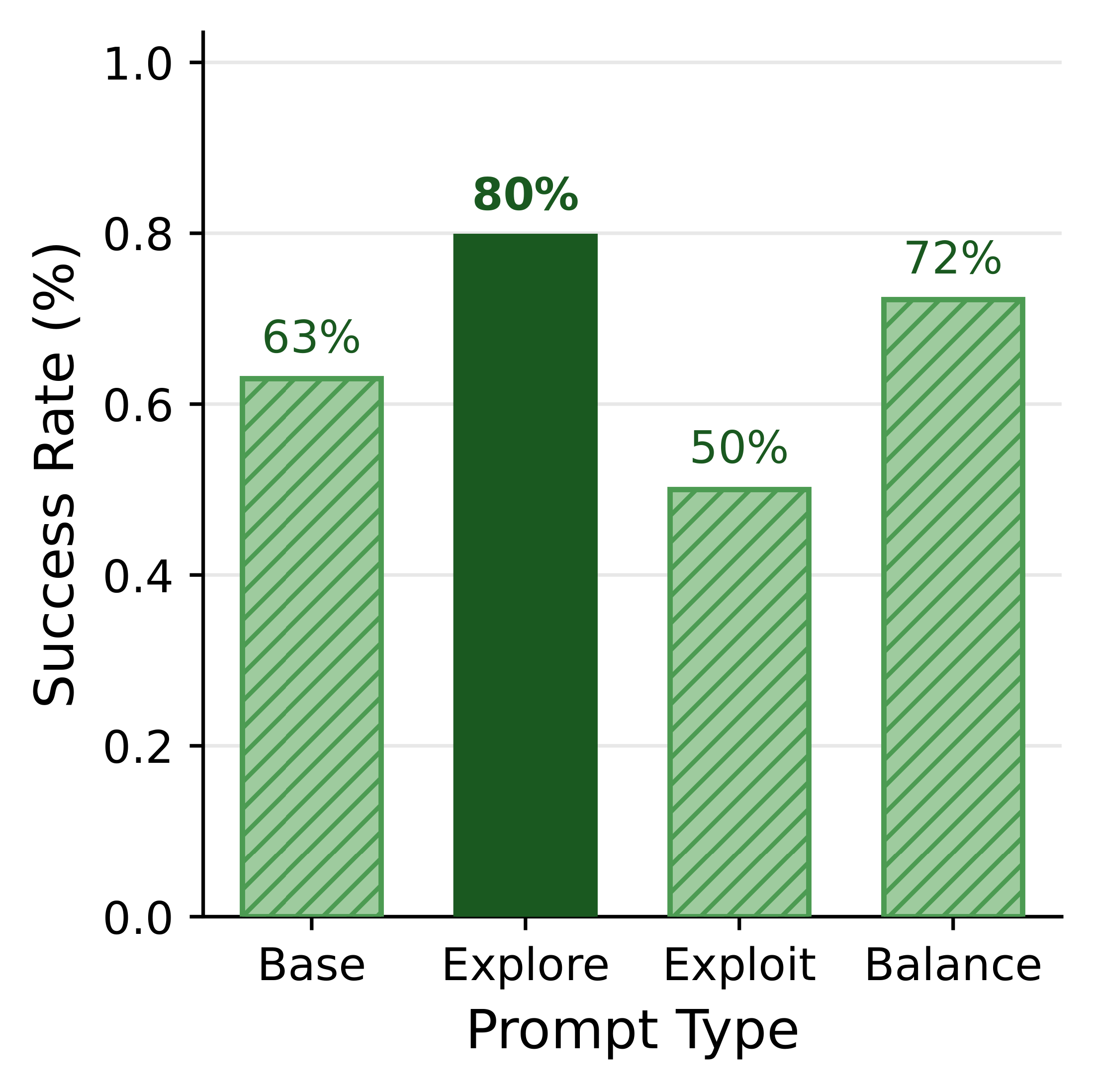
Exploration-focused prompts reduce exploration error, while exploitation-focused prompts reduce exploitation error.
For GPT-4.1, the exploration prompt raises success from 63% to 80%
and lowers exploration error from 0.123 to 0.099.
Figure 4. The prompts share an environment description and action format; only one strategy sentence changes.
Takeaway 4
Structured memory improves success over the reasoning baseline.
A compact summary of previously observed information helps agents act without generating reasoning traces.
Compared with a baseline that retains its own reasoning traces, the harness achieves
higher success, lower exploration error, and lower total step-budget usage for both evaluated models.
The summary organizes existing observations and adds no new environment information.
Table 2. Structured memory compared with the reasoning baseline. Budget usage is averaged over all episodes.
Model
Method
Success ↑
Exploration error ↓
Exploitation error ↓
Avg. budget used ↓
Gemini 3.1 Flash Lite
Reasoning
50.0%
0.190
0.193
77.1%
Structured memory
76.9%
0.144
0.083
64.9%
GPT-4.1
Reasoning
66.7%
0.159
0.227
72.6%
Structured memory
72.2%
0.121
0.293
69.2%
GPT-4.1’s exploitation error increases from 0.227 to 0.293 even as success improves. The separate errors make this tradeoff visible.
Takeaway 5
Semantic information helps exploitation, while exploration is still required.
Replacing arbitrary symbols with meaningful cooking-related names substantially reduces exploitation error,
while exploration error remains similar. Semantic knowledge can help infer task dependencies,
but it does not reveal where the task nodes are located.
Table 3. Semantic versus symbolic task names, with 40 evaluations per condition.
Model
Task names
Success ↑
Exploration error ↓
Exploitation error ↓
Gemini 3.1 Flash Lite
Symbolic
0.0%
0.305
0.405
Semantic
25.0%
0.291
0.061
GPT-4.1
Symbolic
25.0%
0.275
0.456
Semantic
27.5%
0.284
0.219
Figure 5. A semantic task: making tomato pasta with cheese. Knowing the recipe helps with dependencies, but ingredients must still be located.
Takeaway 6
Errors increase with the corresponding task demands.
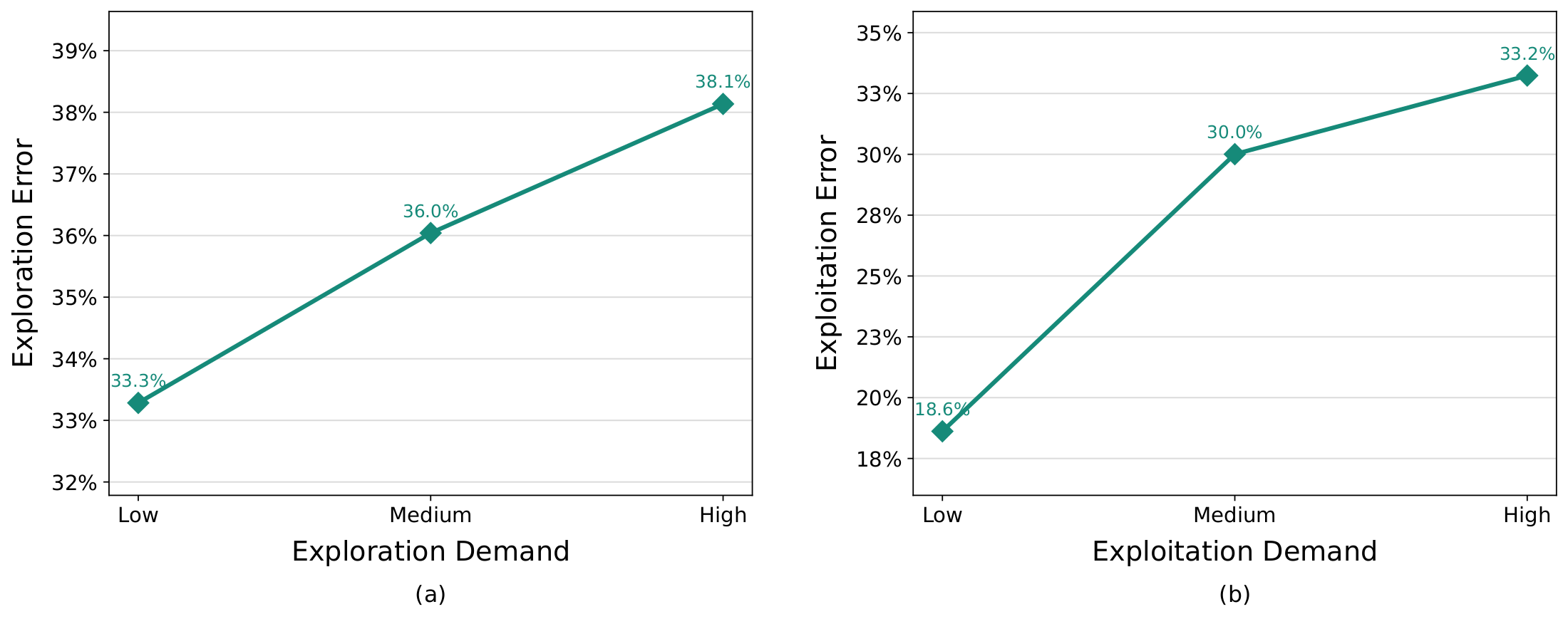
Exploration error rises with exploration demand, and exploitation error rises with exploitation demand.
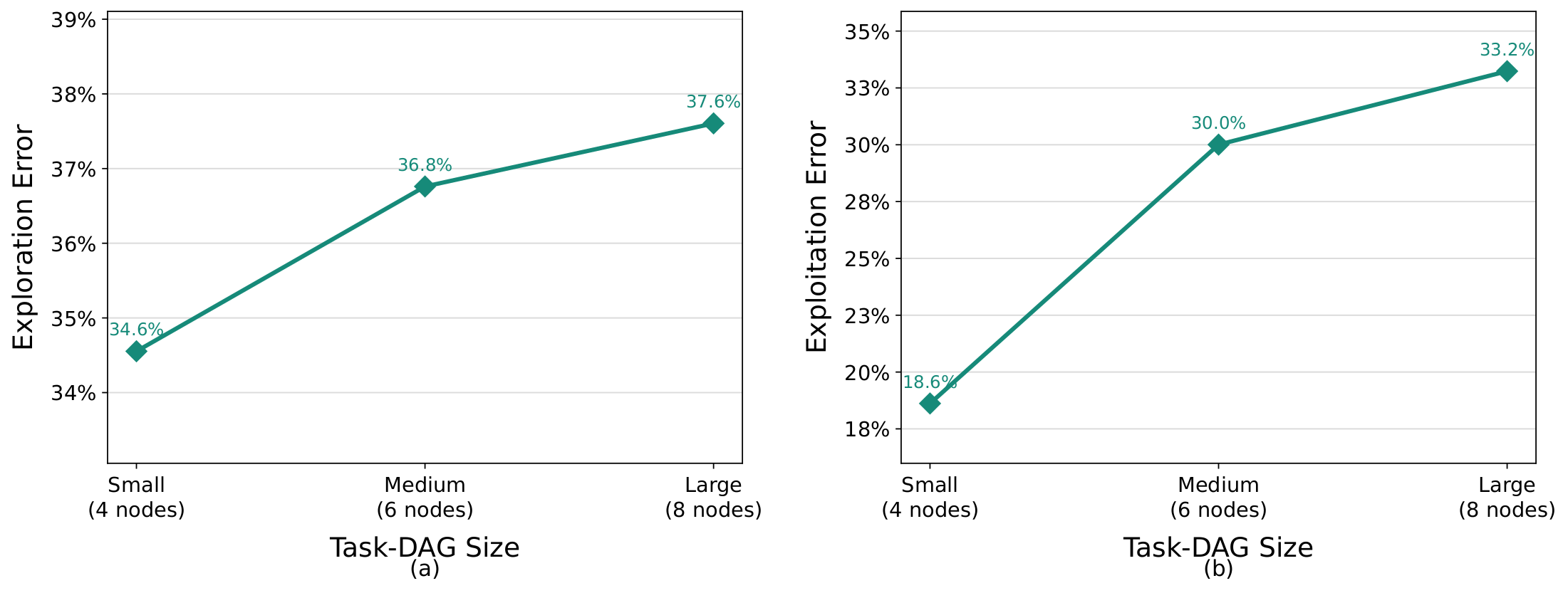
Increasing task DAG size also increases both errors. These controlled changes show that the metrics
respond systematically to the requirements of the task.
Figure 6a. Map design controls exploration and exploitation demand; each panel uses its corresponding demand axis.Figure 6b. Both errors increase with task DAG size. Results are averaged over 35 models, each evaluated on 216 episodes.
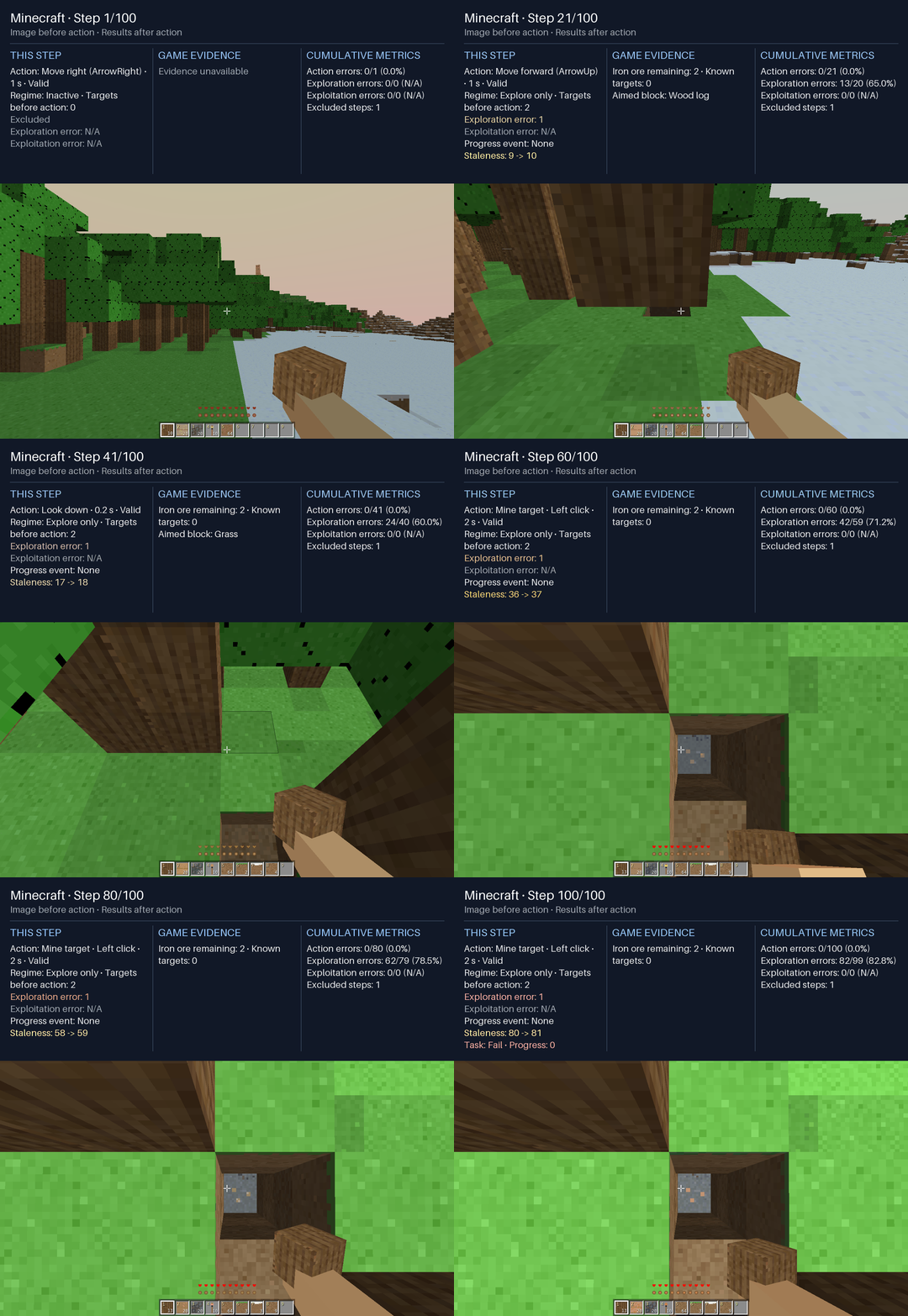
Takeaway 7 / Minecraft Clone
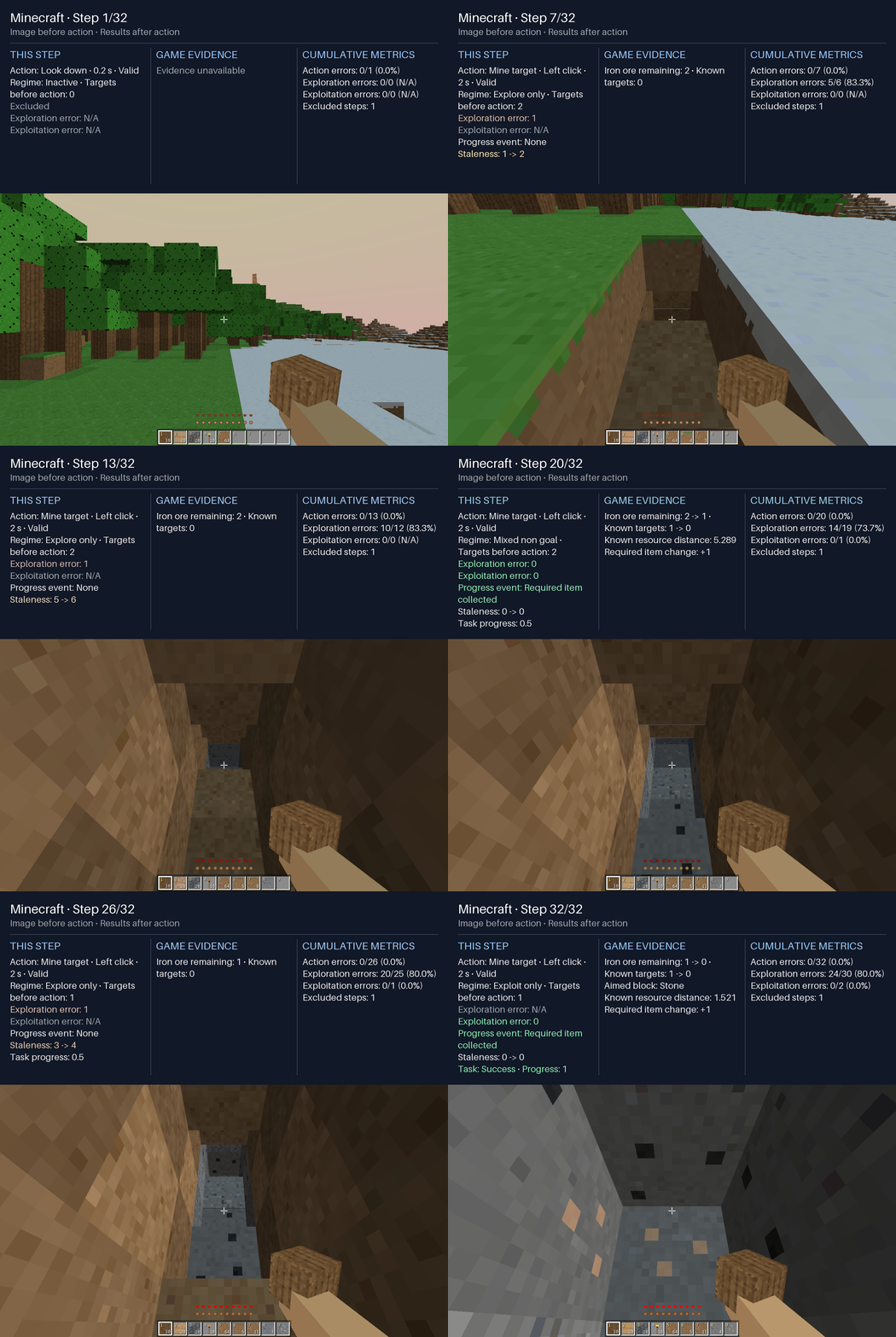
The metric also reveals bottlenecks in a visual 3D environment.
In Minecraft Clone, Gemini 3.1 Flash Lite has zero success despite zero measured exploitation error
without screenshot memory. Its high exploration error points to a discovery bottleneck.
Including up to two prior screenshots improves success and lowers exploration error for both evaluated models.
Figure 7a. Gemini 3.1 Flash Lite: animated trajectory with screenshot memory enabled.Figure 7b. GPT-4.1: animated trajectory with screenshot memory enabled.
Table 4. Minecraft Clone results. Screenshot memory includes up to two prior screenshots.
Model
Screenshot memory
Success ↑
Exploration error ↓
Exploitation error ↓
Gemini 3.1 Flash Lite
Without
0.0%
0.948
0.000
With
88.9%
0.807
0.000
GPT-4.1
Without
11.1%
0.877
N/A
With
77.8%
0.740
0.556
GPT-4.1 still incurs exploitation errors with screenshot memory. Improved success does not imply that every failure mode has been resolved.
03 / Method
Measuring errors from observed actions
Identify productive destinations
Depending on the current state, an agent should discover unseen cells, visit known tasks whose prerequisites are satisfied, or return to the ready goal. When discovery and actionable tasks are both available, either strategy is allowed unless the goal is ready; then the agent must return to it.
Detect unproductive actions
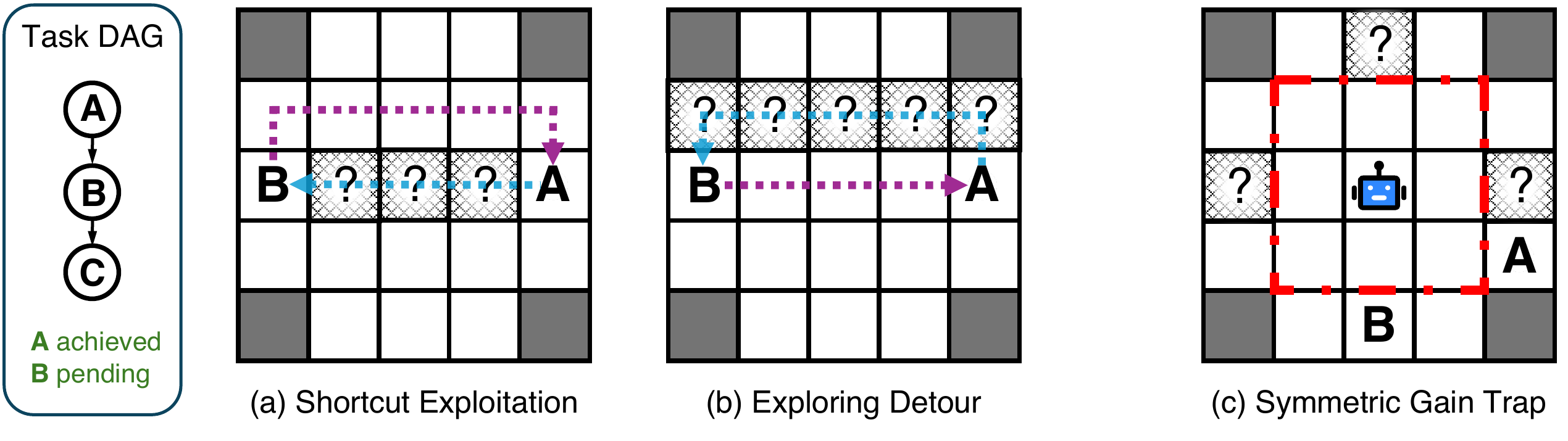
Entering a previously unvisited cell or activating a ready task counts as progress and is error-free. Otherwise, the metric checks whether a move gets closer to any productive destination. With multiple destinations, it also detects loops and excessive revisits during periods without progress, while permitting necessary backtracking.
Attribute each error
Errors count toward exploration, exploitation, or both according to the current state. Each error rate is normalized over the steps where that behavior is relevant, giving a behavioral profile alongside task success.
Figure 8. Unseen shortcuts and useful exploration detours can be reasonable actions. Tracking redundancy also catches repeated wandering that a distance-based gain test alone would miss.
04 / Trajectories
Sample Trajectories
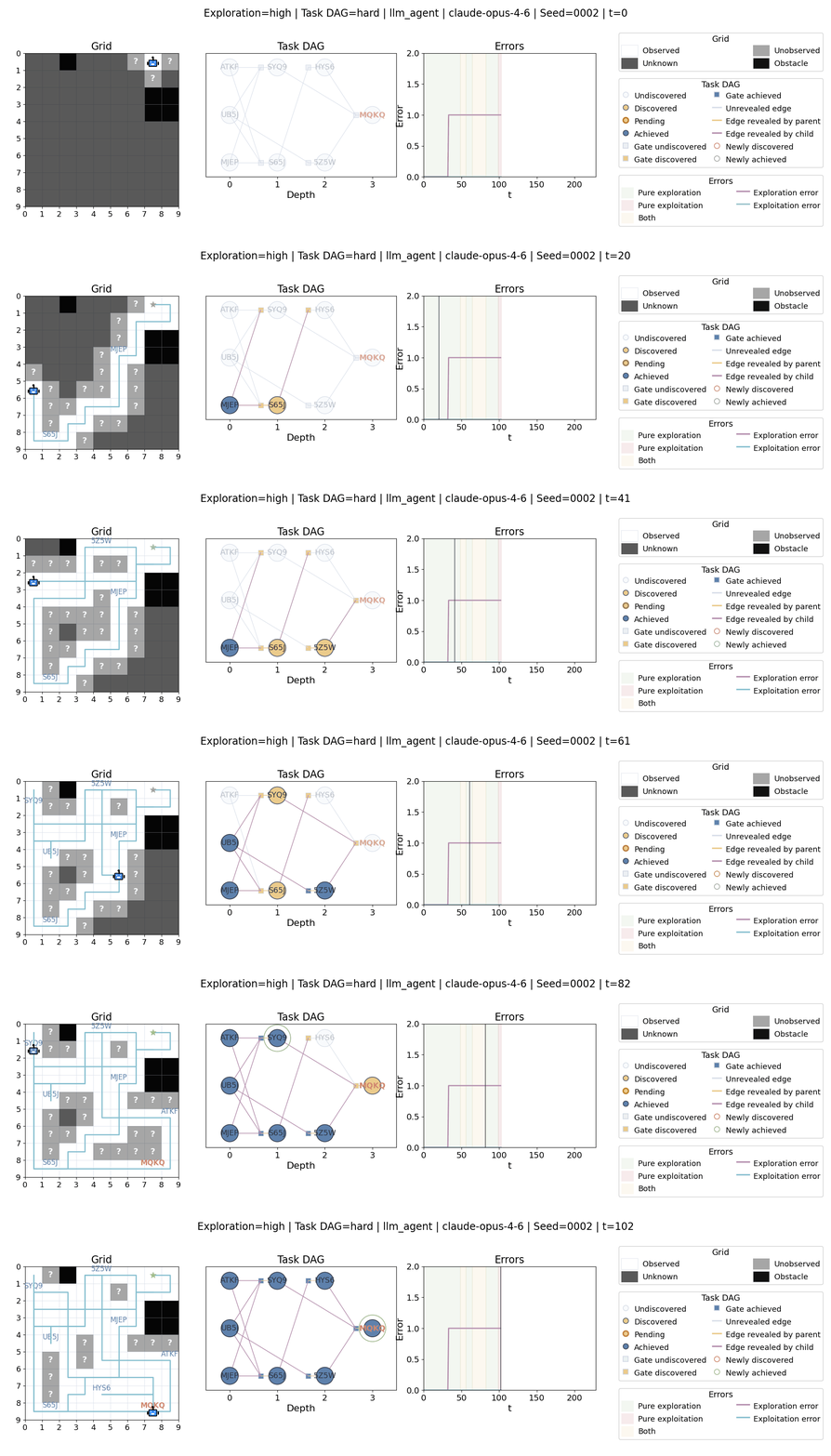
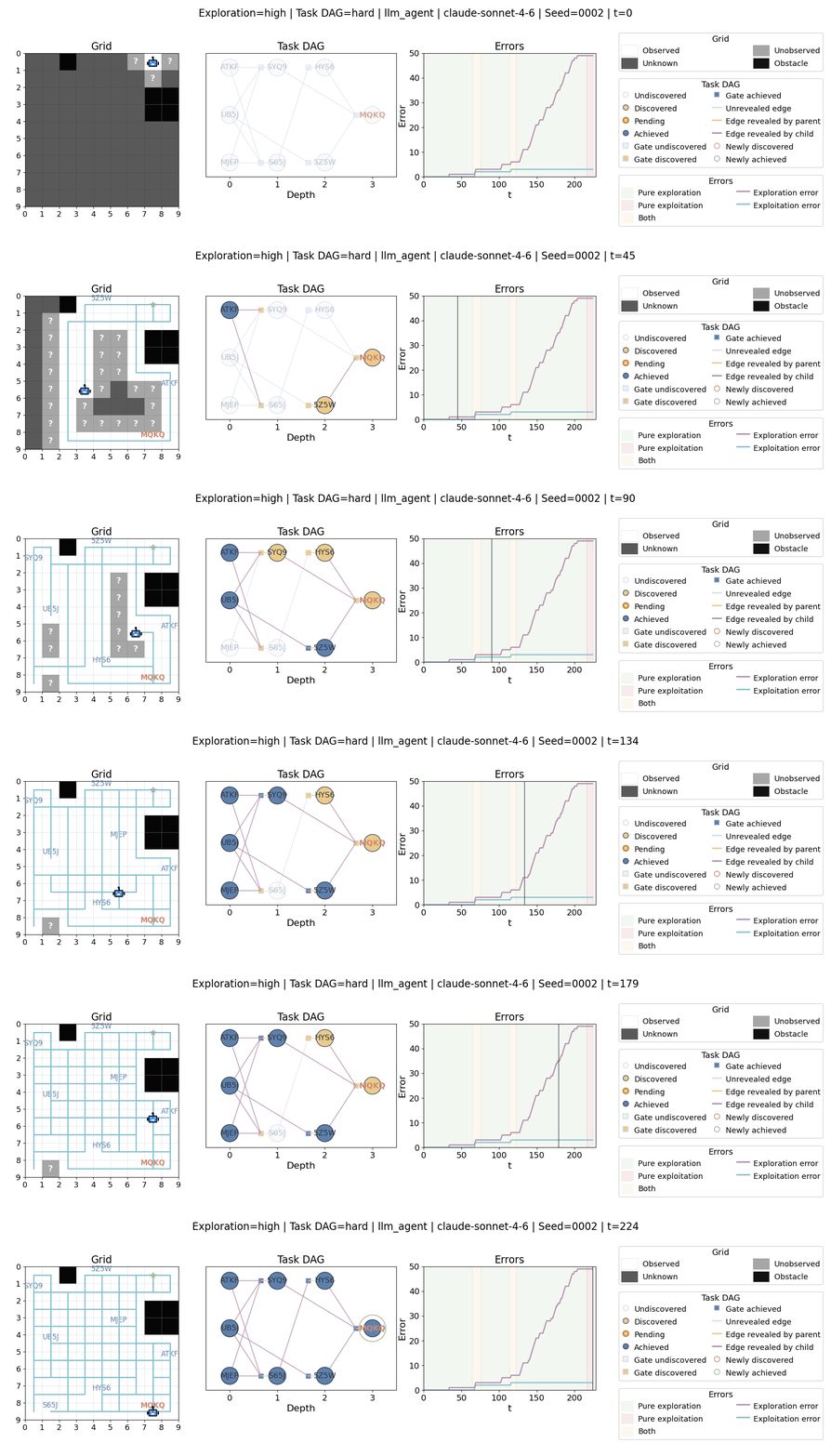
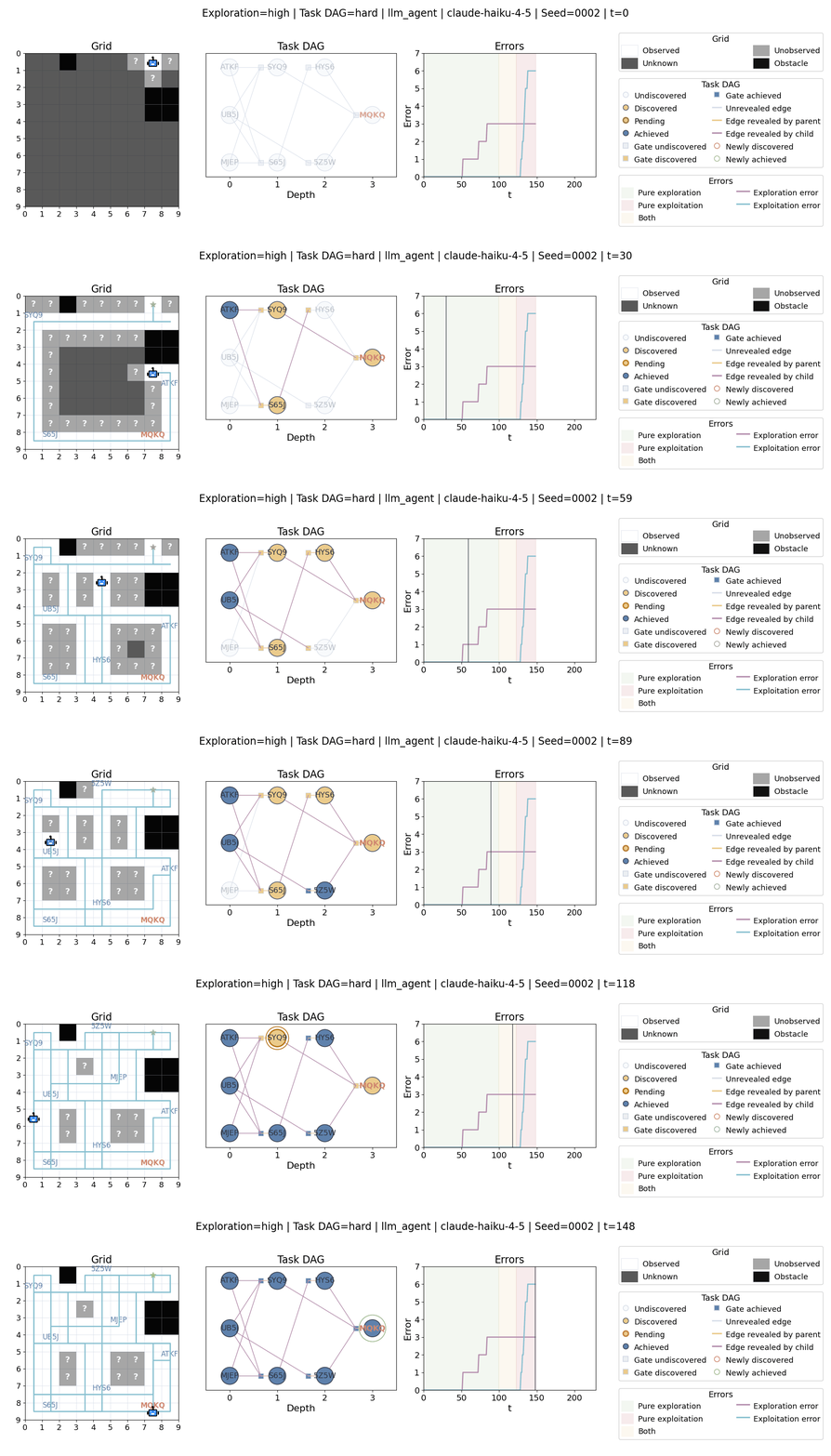
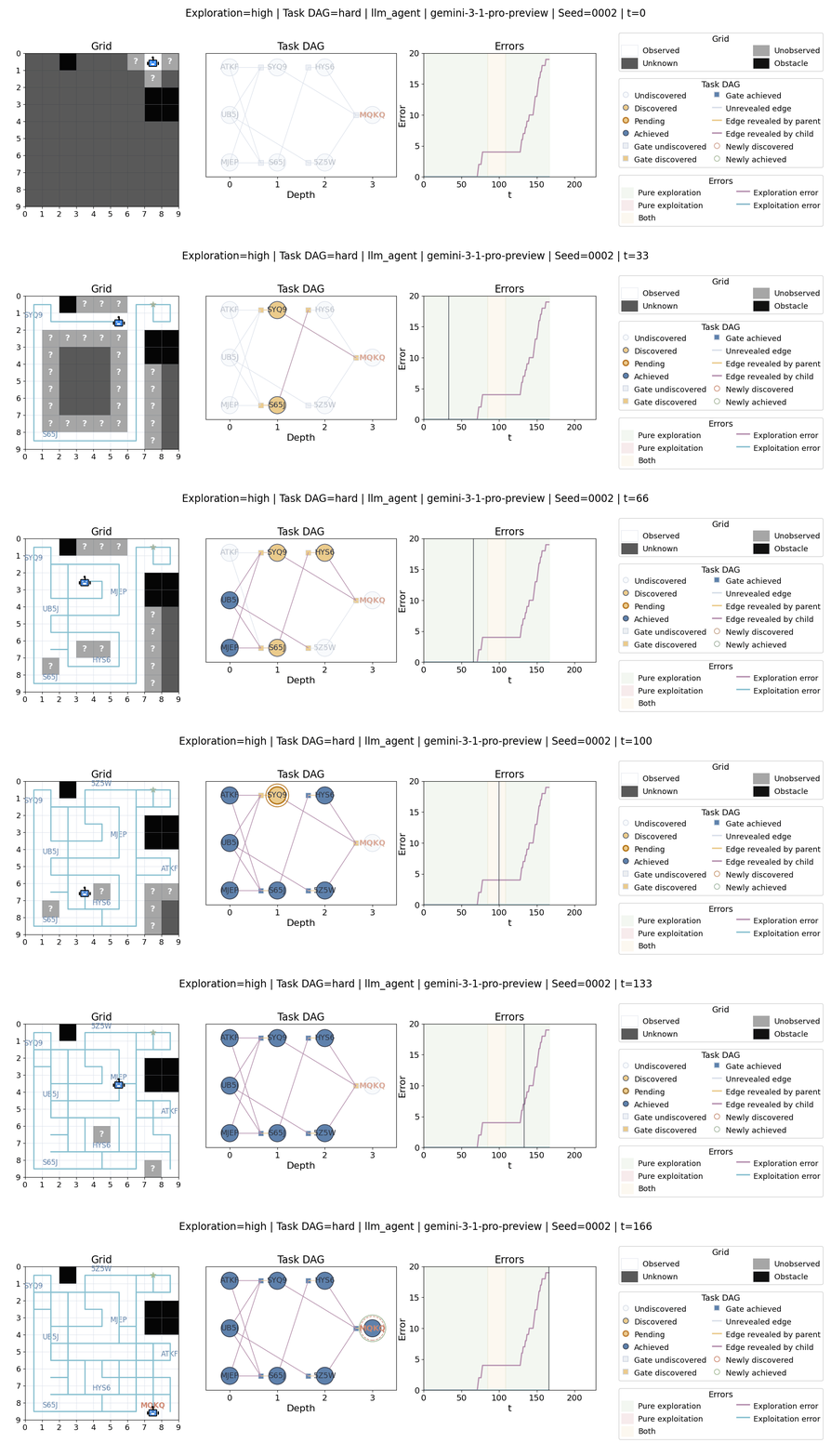
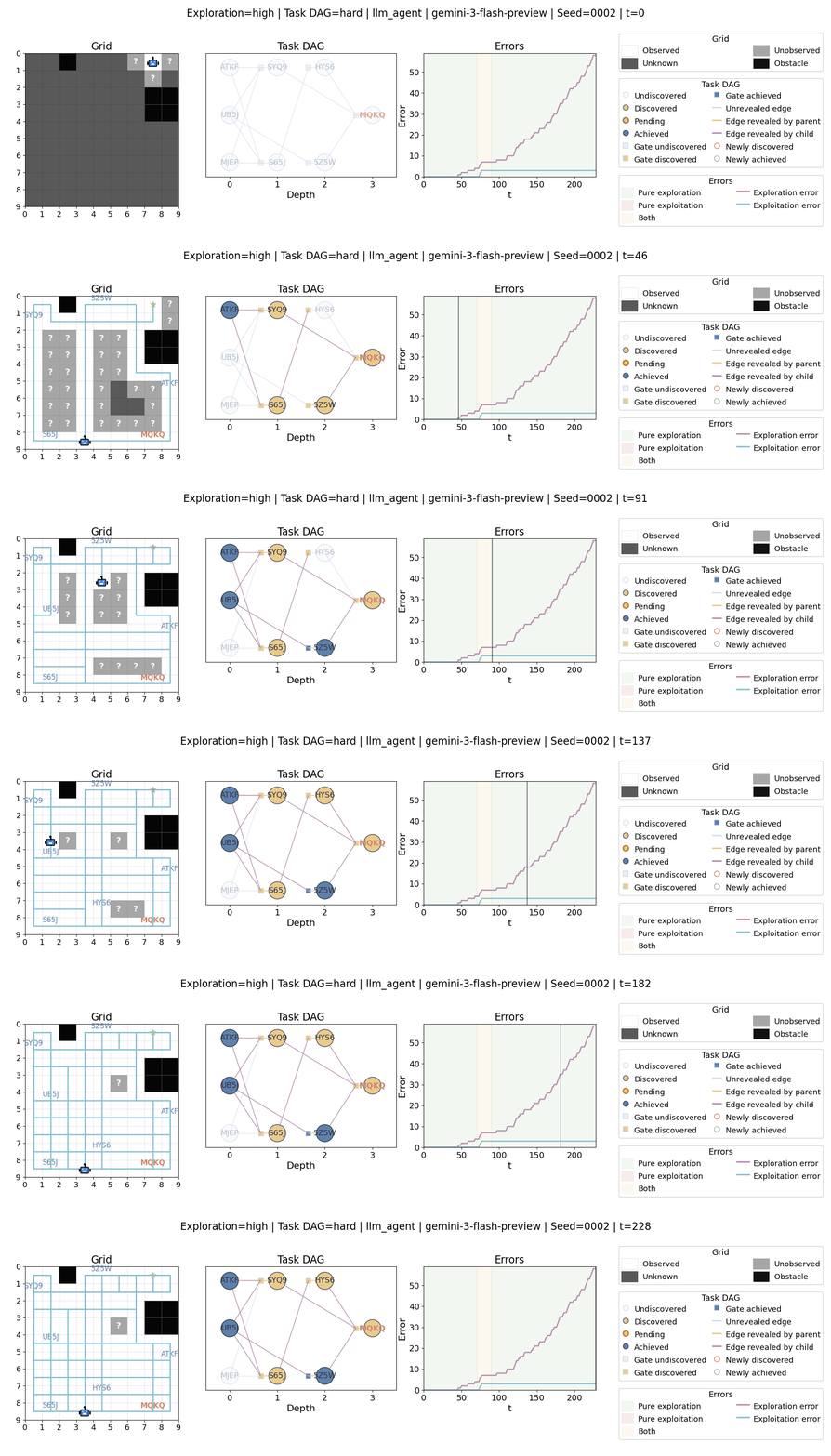
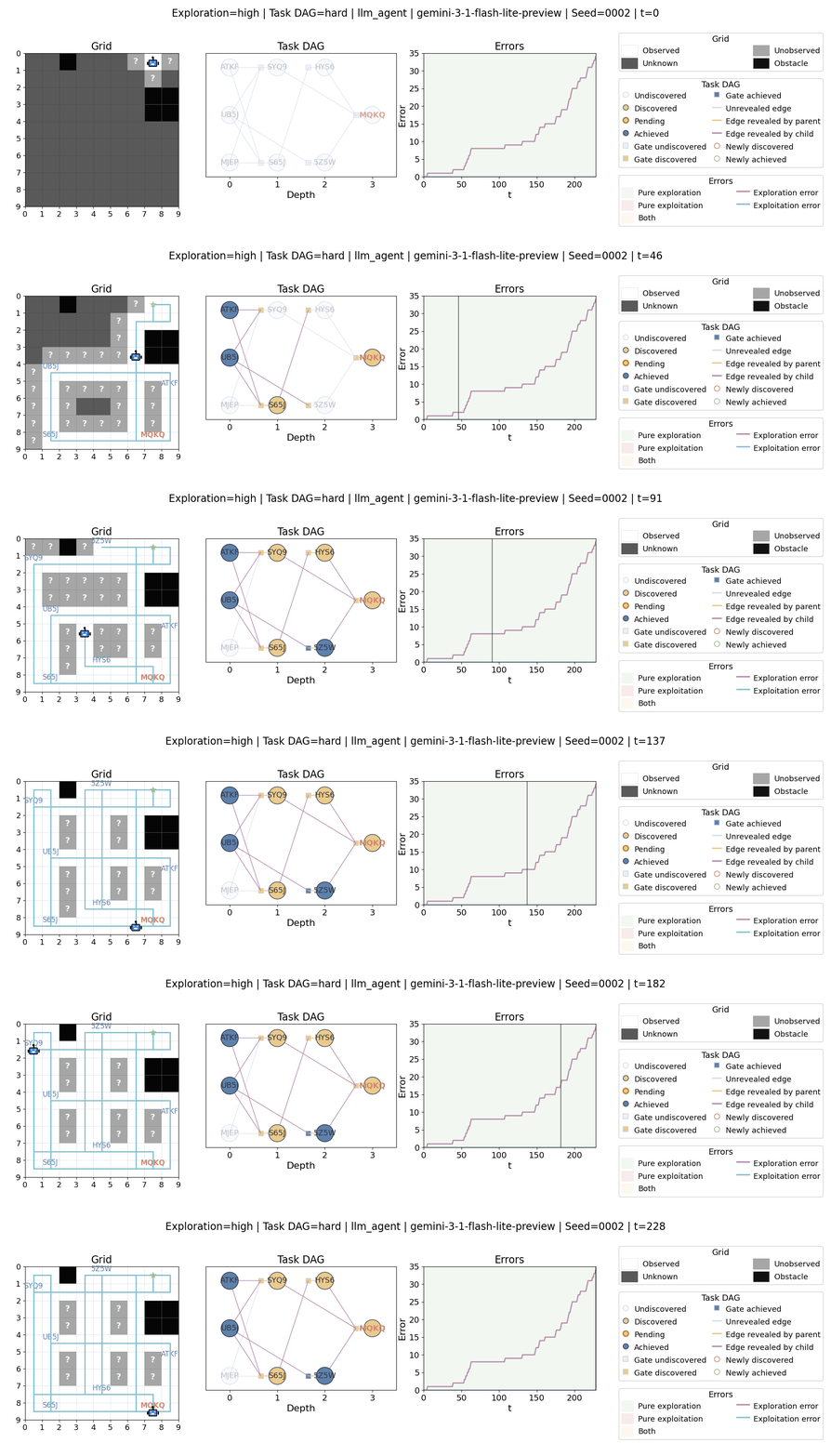
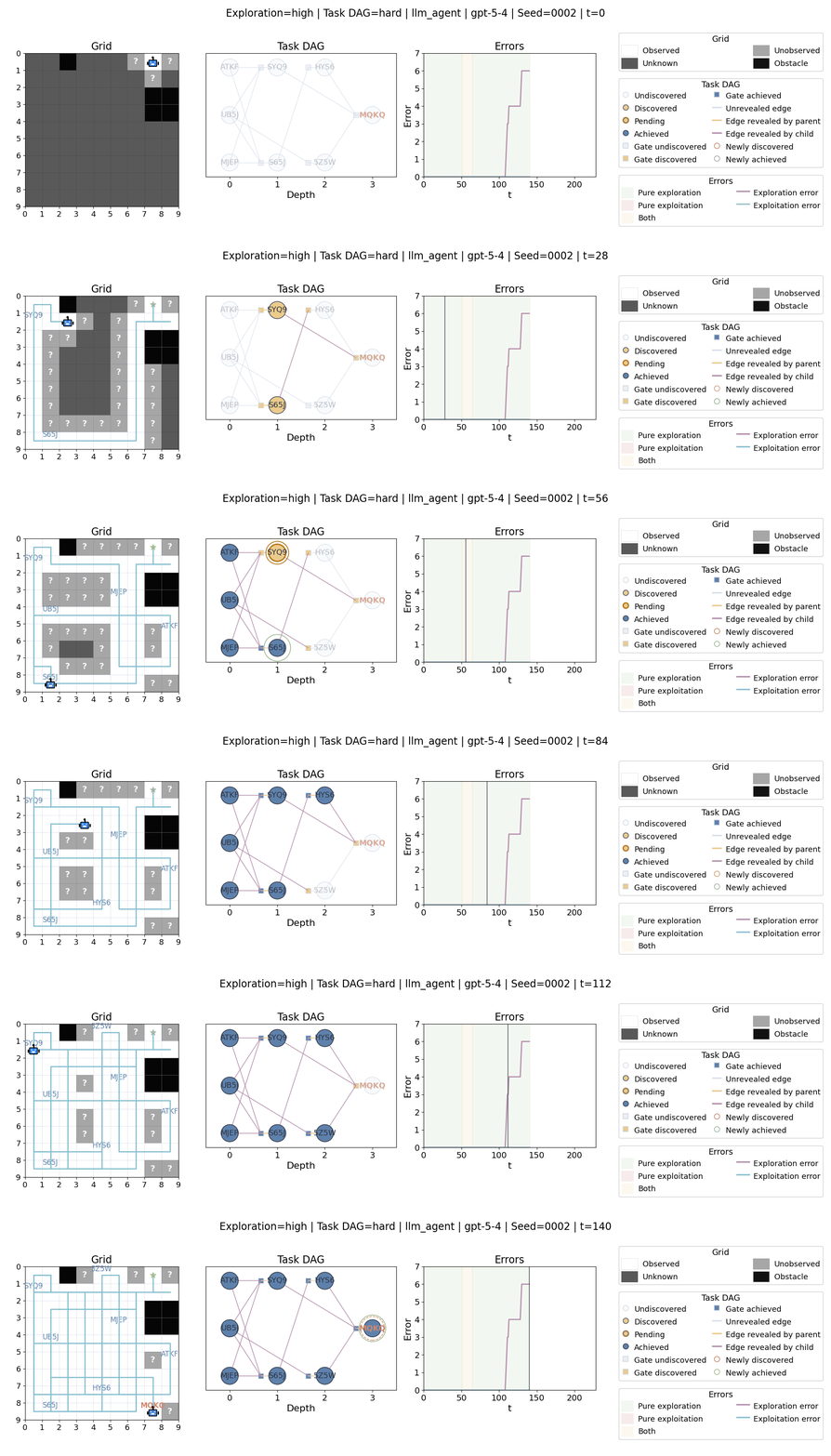
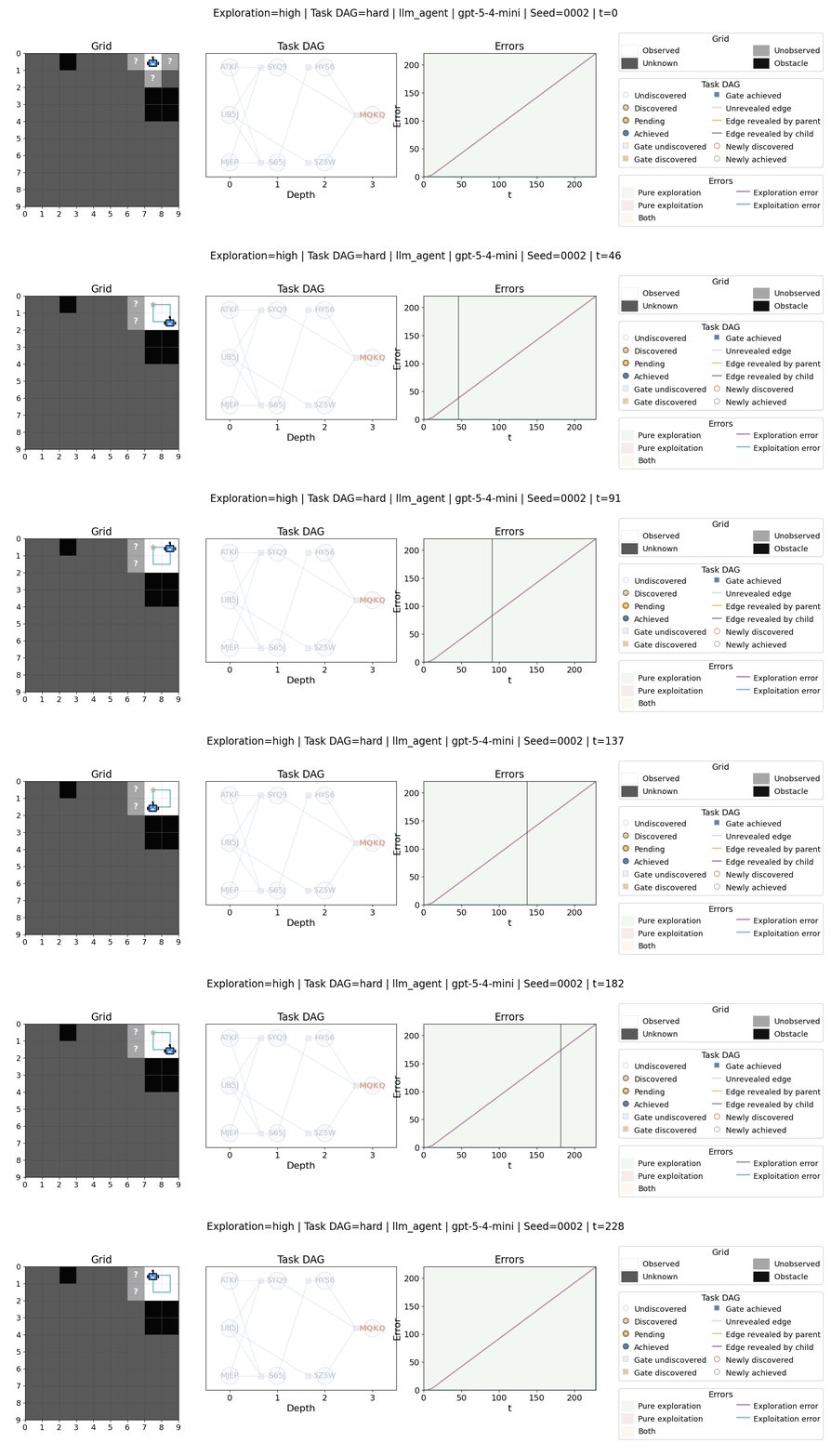
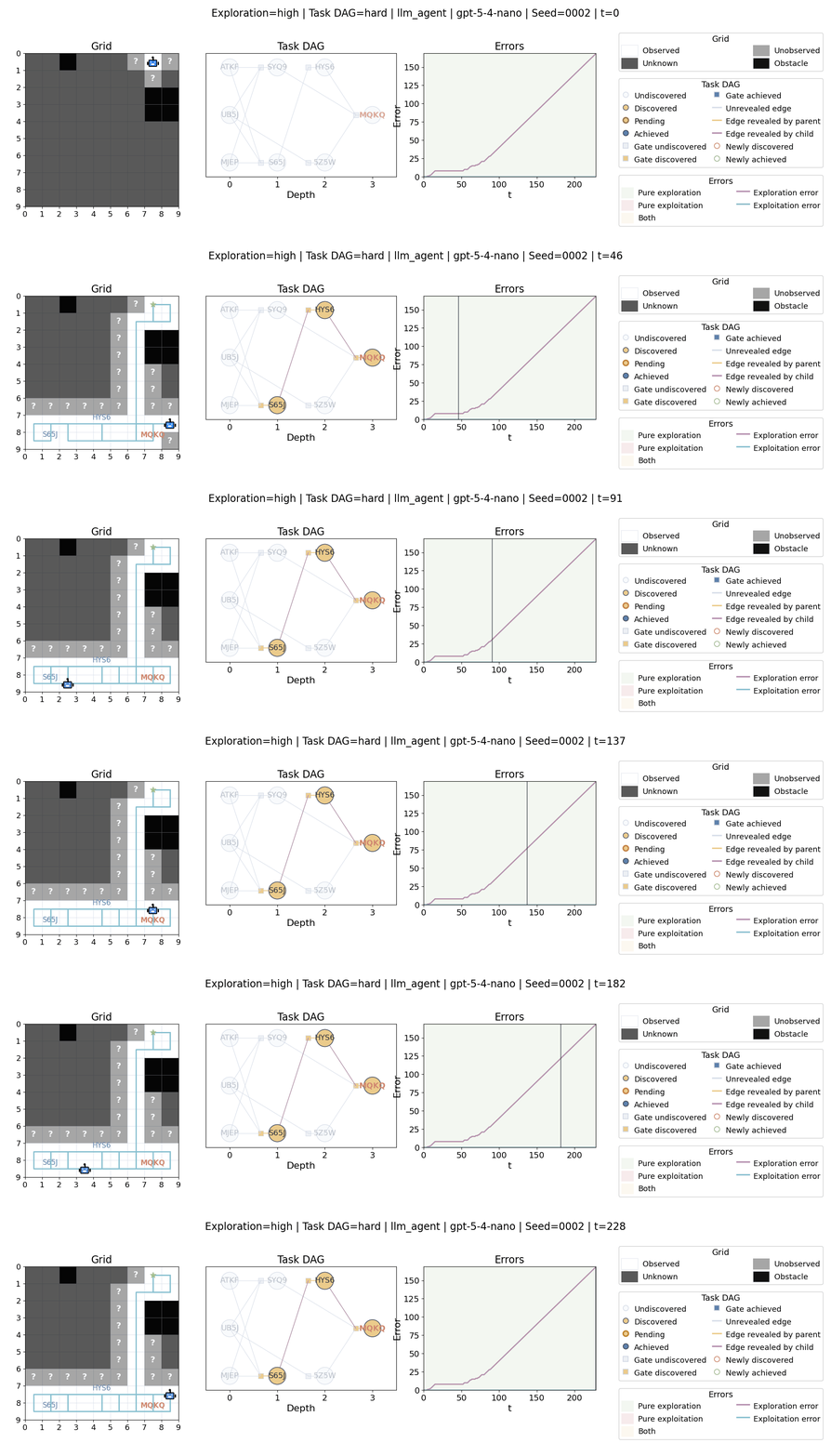
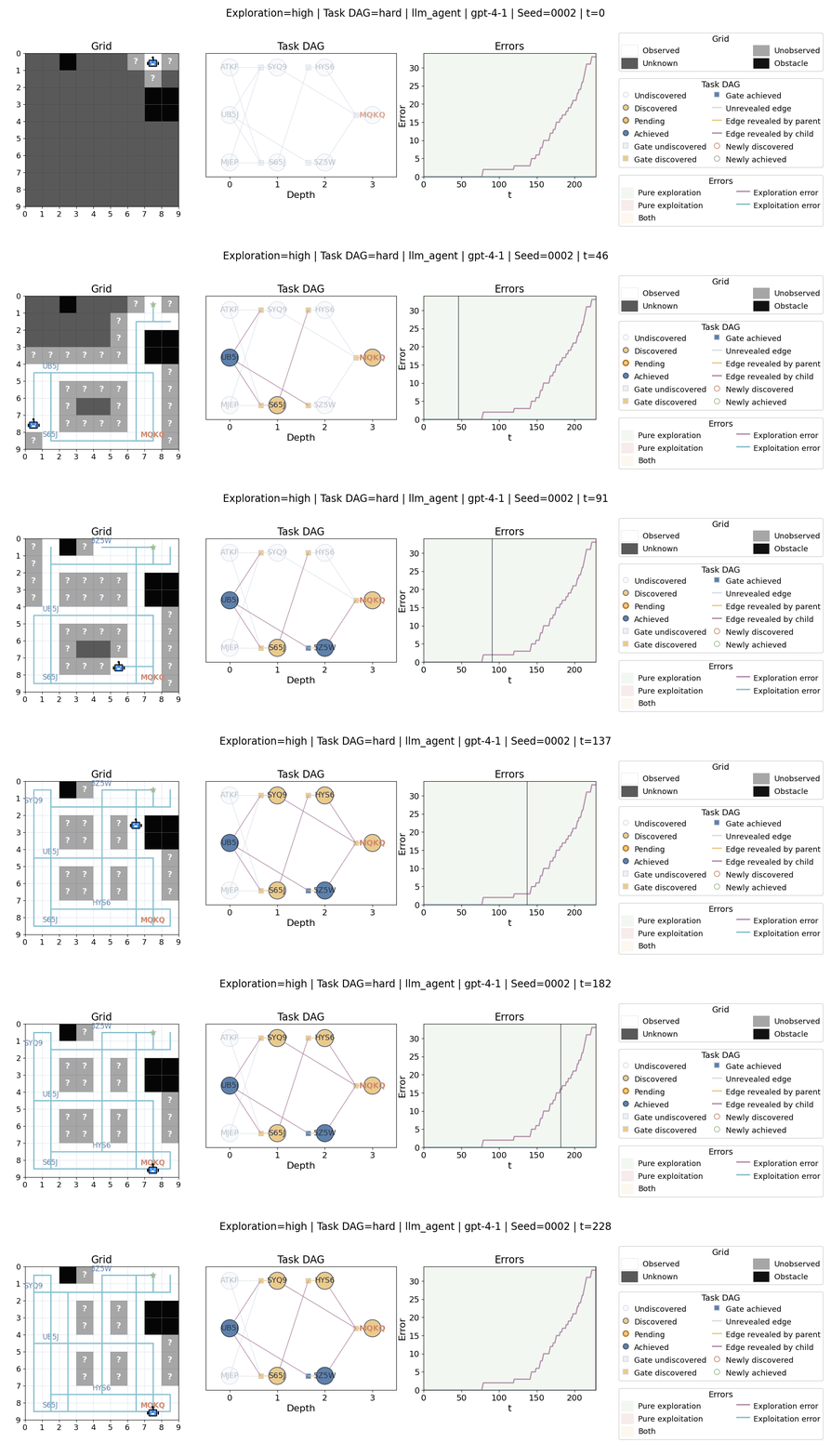
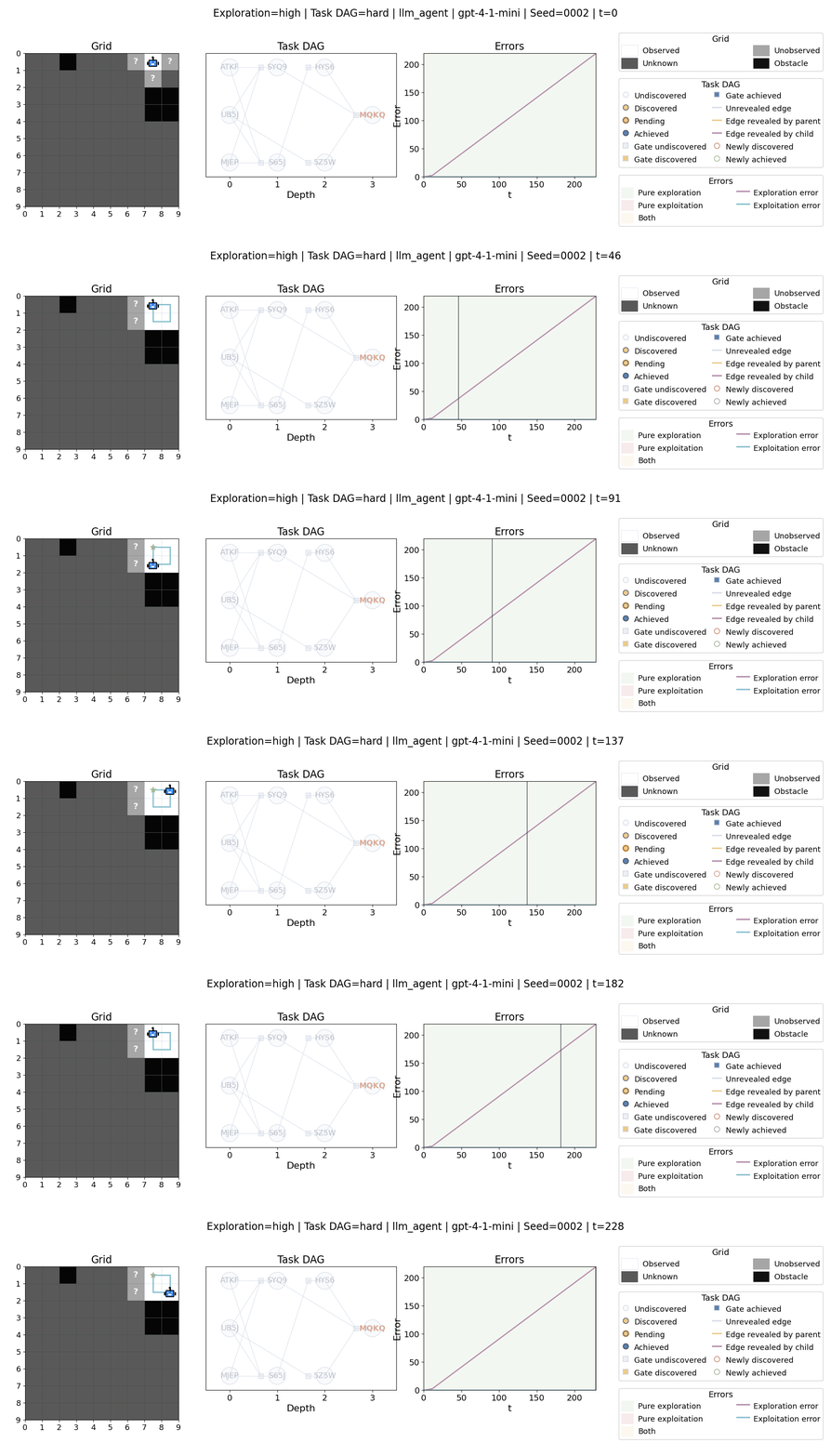
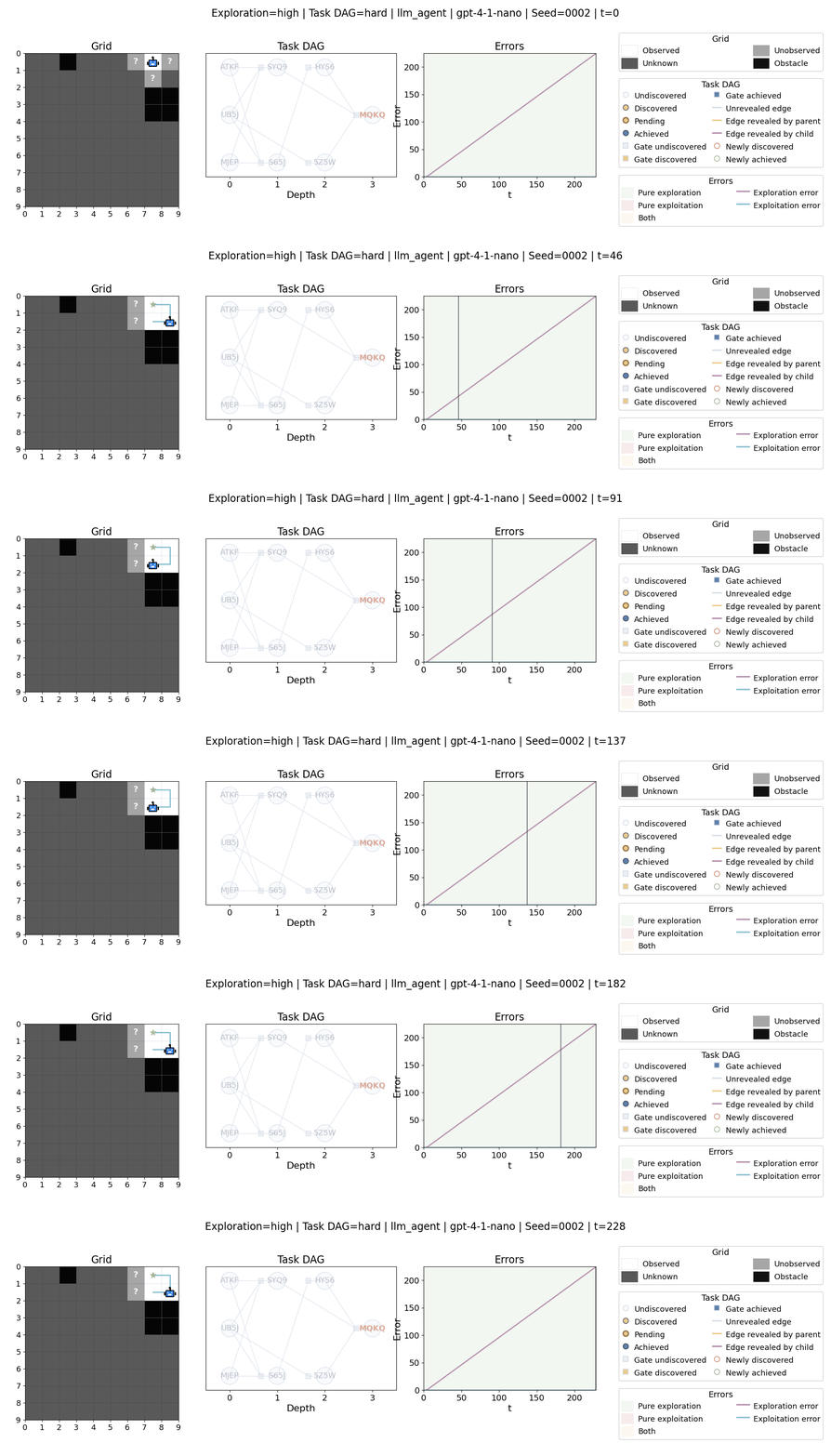
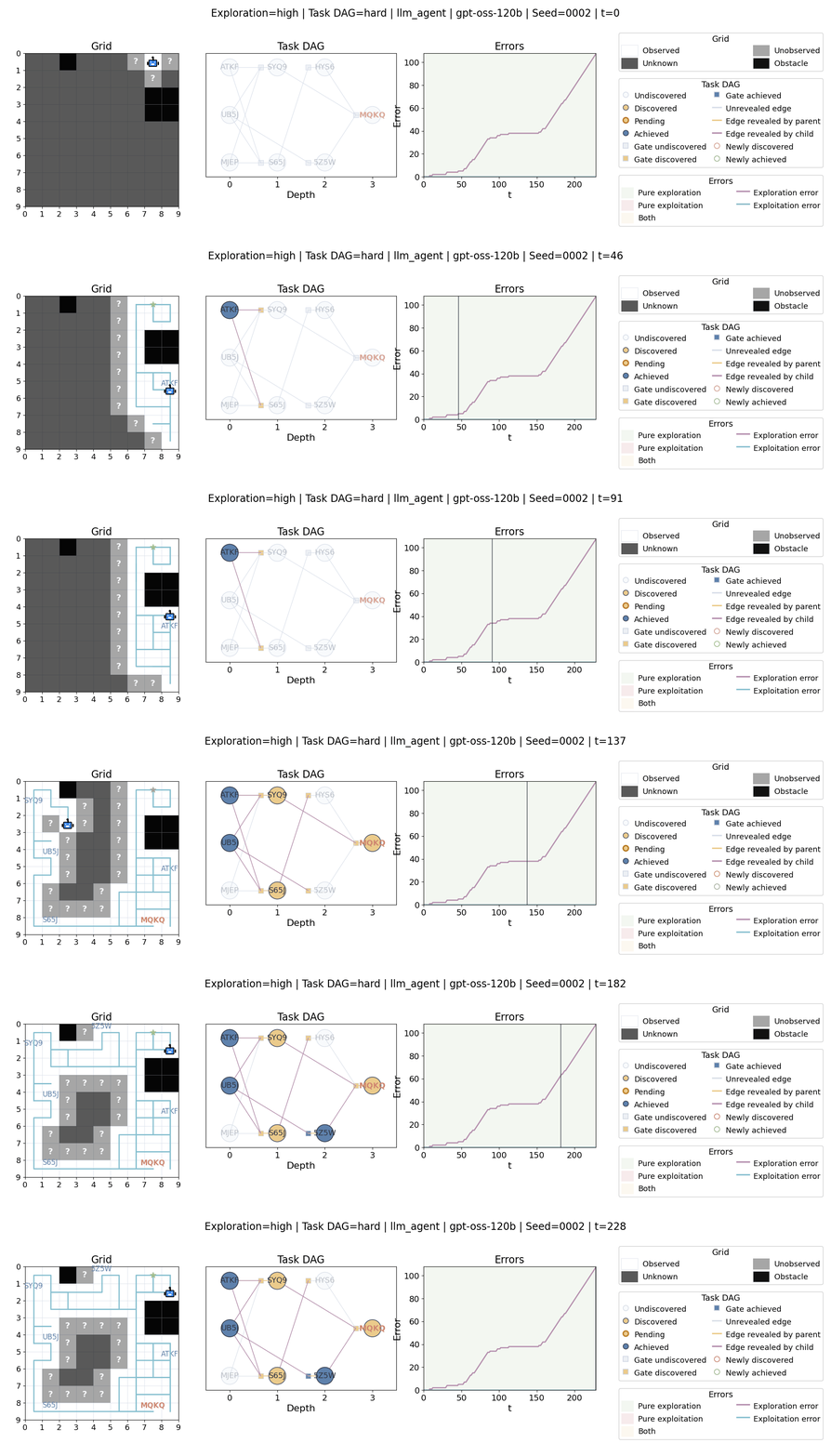
Explore all 13 sample animations. Each uses exploration=high, task_dag=hard, and seed=2. Select an animation to view it at full size.
Claude Opus 4.6
Claude Sonnet 4.6
Claude Haiku 4.5
Gemini 3.1 Pro
Gemini 3 Flash
Gemini 3.1 Flash Lite
GPT-5.4
GPT-5.4 Mini
GPT-5.4 Nano
GPT-4.1
GPT-4.1 Mini
GPT-4.1 Nano
GPT-OSS-120B
05 / Contributions
Key Contributions
Policy-agnostic error measurement
Measure exploration and exploitation errors from action trajectories without inspecting hidden policies or prescribing a single reference strategy, with an extension to Minecraft Clone.
Controllable symbolic environments
Partially observed grid maps and unknown symbolic task DAGs isolate reasoning from semantic priors and allow systematic control of exploration demand, exploitation demand, and task complexity.
Behavioral diagnostics across 35 models
Connect both errors to task success, distinguish failure modes hidden by successful outcomes, and quantify how prompts, structured memory, and semantic information change agent behavior.
06 / Citation
Citation
@article{park2026exploration,
    title={Exploration and Exploitation Errors Are Measurable for Language Model Agents},
    author={Jaden Park and Jungtaek Kim and Jongwon Jeong and Robert D. Nowak and Kangwook Lee and Yong Jae Lee},
    journal={arXiv preprint arXiv:2604.13151},
    year={2026}
}